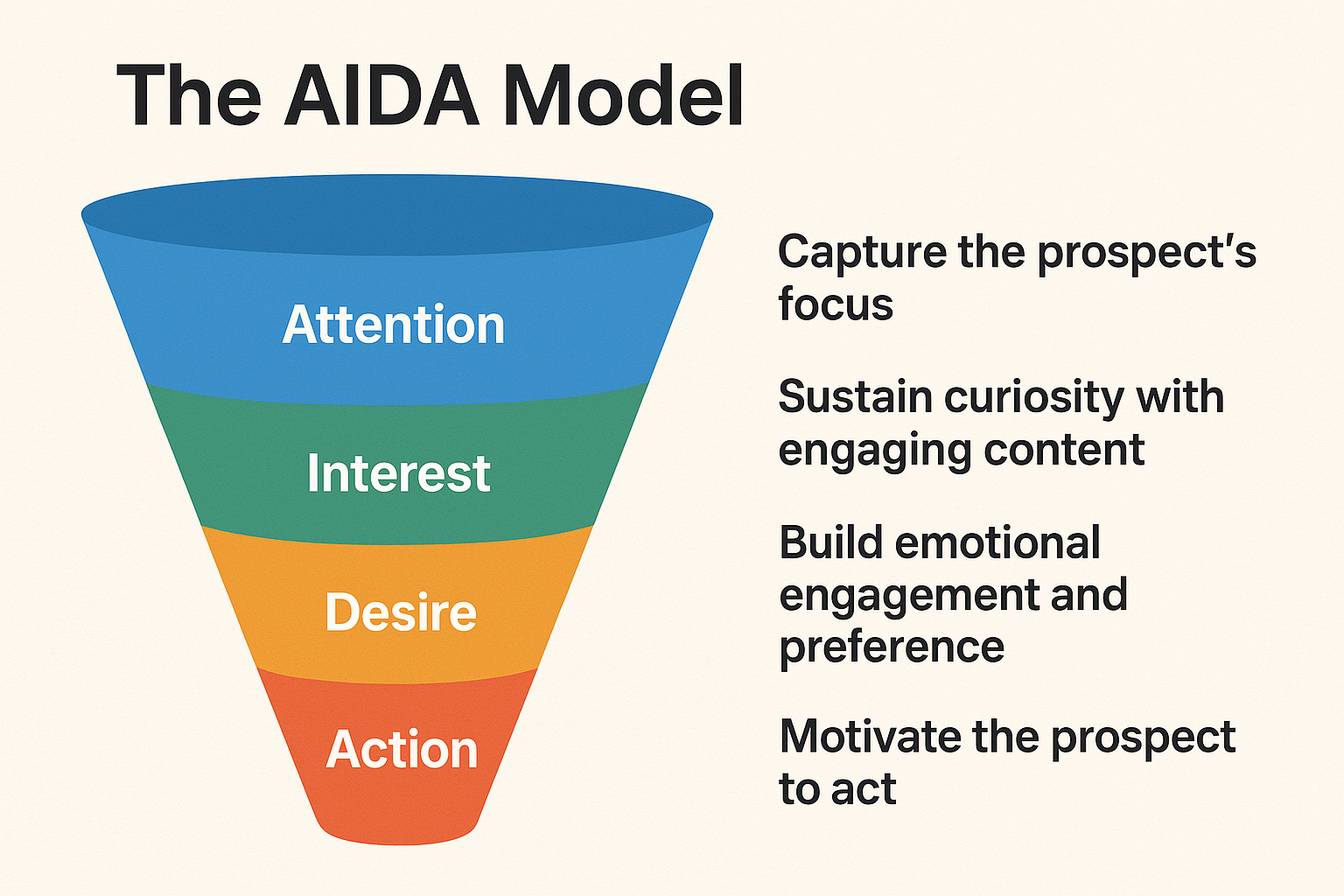
The AIDA model is a foundational marketing framework that describes the stages a customer goes through from first encountering a brand to taking action, such as making a purchase. in this post, we’ll be exploring how this time-tested framework can give momentum to your Brand Flywheel.
The History of the AIDA Model
The AIDA model—standing for Attention, Interest, Desire, and Action—was developed by American advertising advocate Elias St. Elmo Lewis back in 1898. Lewis wanted to outline the essential steps for effective advertising, originally applying the model to sales talks before it became a staple in broader marketing and advertising strategies. Over 125 years later, AIDA remains one of the most widely used models for structuring the customer journey through psychological and emotional triggers, helping marketers map out how consumers move from initial awareness to taking action.
How AIDA Works in Marketing
AIDA describes the progression customers typically follow:
- Attention (or Awareness): Capture the prospect’s focus, often through striking visuals, headlines, or provocative questions.
- Interest: Sustain curiosity by delivering relevant information or addressing pain points meaningful to the audience. (You’ll need to have done some good research into the pain points of your target demographic, but understanding the angst that brought clients to you in the first place will pay off in spades).
- Desire: Build emotional engagement and preference by highlighting product benefits, unique value propositions, social proof, and brand storytelling.
- Action: Motivate the prospect to act, whether it’s making a purchase, signing up, or some other on-brand client activation activity, usually via clear calls-to-action.
AIDA is seen as a funnel—the number of prospects narrows as they progress through the stages, illustrating how widespread attention condenses toward genuine engagement and conversion. Its straightforward sequence makes planning campaigns, structuring content, and measuring performance easier, whether in traditional channels or digital marketing environments. It also gives insights as to the evolving motivations of your ideal customers.
Modern Applications and Adaptability
The AIDA model’s enduring relevance comes from its versatility. In today’s digital landscape, marketers use the framework to guide strategies across social media, email campaigns, landing pages, and AI-driven customer journeys. For example, personalized offers and AI-powered content dynamically nurture interest and desire, while automated recommendations and refined calls-to-action convert users at scale. Metrics like conversion rates, engagement, and customer retention are commonly tracked to evaluate AIDA’s effectiveness, showing it drives meaningful improvements even amid evolving technology and consumer behavior.
AIDA and the Brand Flywheel
The Brand Flywheel emphasizes continuous, customer-driven growth through a cyclical process. The flywheel model revolves around three interconnected phases: Attract, Engage, and Delight. Instead of viewing the customer journey as a linear funnel, the Brand Flywheel treats every interaction as an opportunity to build momentum—when customers are delighted, they bring new prospects into the cycle, fueling further growth and advocacy.
AIDA’s stages map naturally onto the Brand Flywheel:
- Tell Your Story (create Awareness and Interest) using your unique content, SEO, and inbound marketing to draw and then engage prospects.
- Engage (build Desire), nurturing relationships and emotional connections that convert attention into brand preference.
- Capture Business (Action) by attracting leads, nurturing prospects, and selling products or services that meet your ideal customers’ needs.
- Delight and Inspire (continued Action), focusing on exceeding expectations, prompting referrals, and sustaining loyalty that renews the flywheel’s momentum.
From Funnel to Flywheel
AIDA remains an essential framework for understanding and influencing buyer behavior in any era. When integrated with the Brand Flywheel, it transforms from a one-way funnel into a circular momentum-builder—each customer not only acts, but has the potential to attract and inspire others, amplifying your brand’s impact far beyond individual conversions. By combining the structure of AIDA with the dynamism of the flywheel, you can build lasting relationships and drive exponential growth of your brand.